What should a decision log include?
By Ross Mercer · Updated
A decision log should include the date, the decision in one sentence, the options you considered and rejected, what you expect to happen stated specifically enough to be wrong, your reasoning and key assumption, your confidence, and a revisit date. At the revisit, record what happened, whether the call was sound given what you knew, and one change.
Why keep a decision log at all?
Because memory edits past decisions to match how they turned out. If a call worked, you remember seeing it coming. If it failed, you remember having doubts all along. Both versions feel like memory, and neither is a record.
Psychologists call this hindsight bias. In Baruch Fischhoff’s 1975 experiments, people who were told how an event turned out judged that outcome more likely, and were “largely unaware of the effect that outcome knowledge had on their perceptions.” The paper concludes that “this lack of awareness can seriously restrict one’s ability to judge or learn from the past.”
For a manager, the lesson memory teaches is always the flattering one, so confidence grows while accuracy stays flat. A note written before the outcome is evidence. A note written after is already contaminated.
Which fields does a decision log need?
Seven fields when you decide, four when you revisit. The test for every field: would it help you grade the call in three months? If not, cut it. The “what” is the least useful part, because you will remember it. The “why” is what evaporates.
- Field
- Date
- What to write
- The day you made the call
- Why it matters
- Shows the entry came before the outcome
- Field
- Decision
- What to write
- One sentence: what, by when, whose call
- Why it matters
- If you can’t say it in one line, it isn’t a decision yet
- Field
- Options considered
- What to write
- The chosen option, plus each rejected one with a one-line reason
- Why it matters
- A call looks great if you forget the better option you waved off
- Field
- What I expect
- What to write
- A result specific enough to be wrong: roughly what, roughly by when
- Why it matters
- “I expect this to go well” can absorb any outcome
- Field
- Why
- What to write
- The reasoning, the key assumption, and the early signal you’ll watch
- Why it matters
- Tells you later which belief carried the weight
- Field
- Confidence
- What to write
- Sure, fairly sure, or coin flip (a rough percentage works too)
- Why it matters
- The field people skip and the one that teaches most
- Field
- Revisit by
- What to write
- The date reality should have reported back
- Why it matters
- Without it, the log is a write-only archive
- Field
- What happened (revisit)
- What to write
- The actual result
- Why it matters
- The raw material for grading
- Field
- Vs. expected (revisit)
- What to write
- How it compares with your expectation
- Why it matters
- Shows the direction of your misses
- Field
- Sound given what I knew? (revisit)
- What to write
- Yes, or no and what you could have caught
- Why it matters
- Separates a bad decision from a bad outcome
- Field
- One change (revisit)
- What to write
- One adjustment to how you decide, not just what you chose
- Why it matters
- Turns the entry into a better next call
What does a filled-in entry look like?
Here is a generic example. Swap the brackets for your own details. Writing it takes about two minutes; the revisit takes about three.
- Field
- Date
- Entry
- [March 4]
- Field
- Decision
- Entry
- [Team] signs a one-year contract with vendor B for [service], starting [April 1]. My call.
- Field
- Options considered
- Entry
- Chosen: vendor B, one-year term. Rejected: vendor A (cheaper, but no [feature] we need by Q2). Rejected: keep the current setup (open support tickets keep rising).
- Field
- What I expect
- Entry
- Onboarding finished within six weeks. Support replies within one business day on 90% of tickets by month three.
- Field
- Why
- Entry
- B is the only option with [feature]. Key assumption: their onboarding team has capacity this quarter. Early signal: kickoff booked within two weeks.
- Field
- Confidence
- Entry
- Fairly sure (about 70%)
- Field
- Revisit by
- Entry
- [July 1]
- Field
- What happened
- Entry
- Onboarding took nine weeks. The reply target was met from month two.
- Field
- Vs. expected
- Entry
- Three weeks late on onboarding; service as expected.
- Field
- Sound given what I knew?
- Entry
- Mostly yes. I could have asked a reference how long onboarding really took.
- Field
- One change
- Entry
- On any vendor switch, ask two references for their actual onboarding time. File closed.
Which decisions belong in the log?
Only the ones worth grading: calls where you committed to something, the stakes were real, and the outcome will tell you whether your reasoning held. Skip the routine, reversible calls you make twenty times a day. If you are unsure which is which, the undo test for reversible and irreversible decisions sorts them quickly.
Keep each entry to about two minutes. A log usually dies by being too heavy: twelve fields and a scoring rubric, filled in beautifully for two weeks, then abandoned. The opposite failure is an entry like “Picked vendor B,” which has nothing to grade.
Forgot to log one? Write it anyway and mark it “RETRO.” The options and reasoning are often recoverable, but leave retro entries out when you check your confidence, because hindsight has already been at work. If more than a third of your entries are retro, move the log to wherever you are when you decide, such as a phone note or the calendar invite for the meeting.
How do you review a decision log later?
Twice. Each entry gets its own revisit on the date you set, then you close the file. Every quarter, take thirty minutes alone with the entries whose revisit dates have passed and ask six questions:
- Which calls landed close to what I expected, and what do they have in common?
- Which missed, and in which direction? Underestimated time, trusted a polished analysis, decided while rushed?
- What pattern shows up across the misses? One bad call is noise; three of the same shape is a pattern.
- Did calls marked “sure” land more often than “coin flip” calls? If not, give your certainty less weight.
- Which decisions recurred? Each cluster is a candidate for a short template.
- What is the one thing I’ll change? One, not ten.
Why separate a bad decision from a bad outcome?
The “sound given what I knew?” line is the most important one in the revisit. A sound call can lose and a careless one can get lucky. Grade only by outcome and you will learn to stop deciding after a sound loss, and to stay careless after a lucky win. In five studies by Baron and Hershey (1988), people rated a decision maker’s thinking as better when the outcome was favorable than when it was unfavorable, even though they knew they had all the information the decision maker had. More on this in how to decide when you can’t be sure.
Write the revisit in a flat tone, like a short report on your own process. If it reads like a confession, you have missed the point.
Read together, entries show when you decide badly, such as at the end of a long day or on someone else’s urgent timeline. They also answer “how long do projects like this usually take us?” in your own hand. That is the outside view described by Kahneman and Lovallo: start from how similar cases went, not from the details of your plan.
Should you share your decision log?
Keep the raw log private. If someone else will read it, you will shade the entries: cleaner reasoning, softer expectations, no embarrassing assumptions. Then the log lies in the same direction your memory does. Share what it produces instead, such as a hiring template or a lesson like “estimates that depend on a client’s staff run long.” A shared team record of group decisions is useful too, but keep it separate; its job is to stop the team relitigating settled questions.
Sources
- Fischhoff (1975), Hindsight is not equal to foresight: The effect of outcome knowledge on judgment under uncertainty, Journal of Experimental Psychology: Human Perception and Performance 1(3)
- Kahneman & Lovallo (1993), Timid Choices and Bold Forecasts: A Cognitive Perspective on Risk Taking, Management Science 39(1)
- Baron & Hershey (1988), Outcome bias in decision evaluation, Journal of Personality and Social Psychology 54(4)
More guides
- How do you make a decision when you don’t have all the information?
- How do you tell a reversible decision from an irreversible one?
- How do you give negative feedback to an employee?
- How do you start a difficult conversation with an employee?
- What should a first-time manager know before their first difficult conversation?
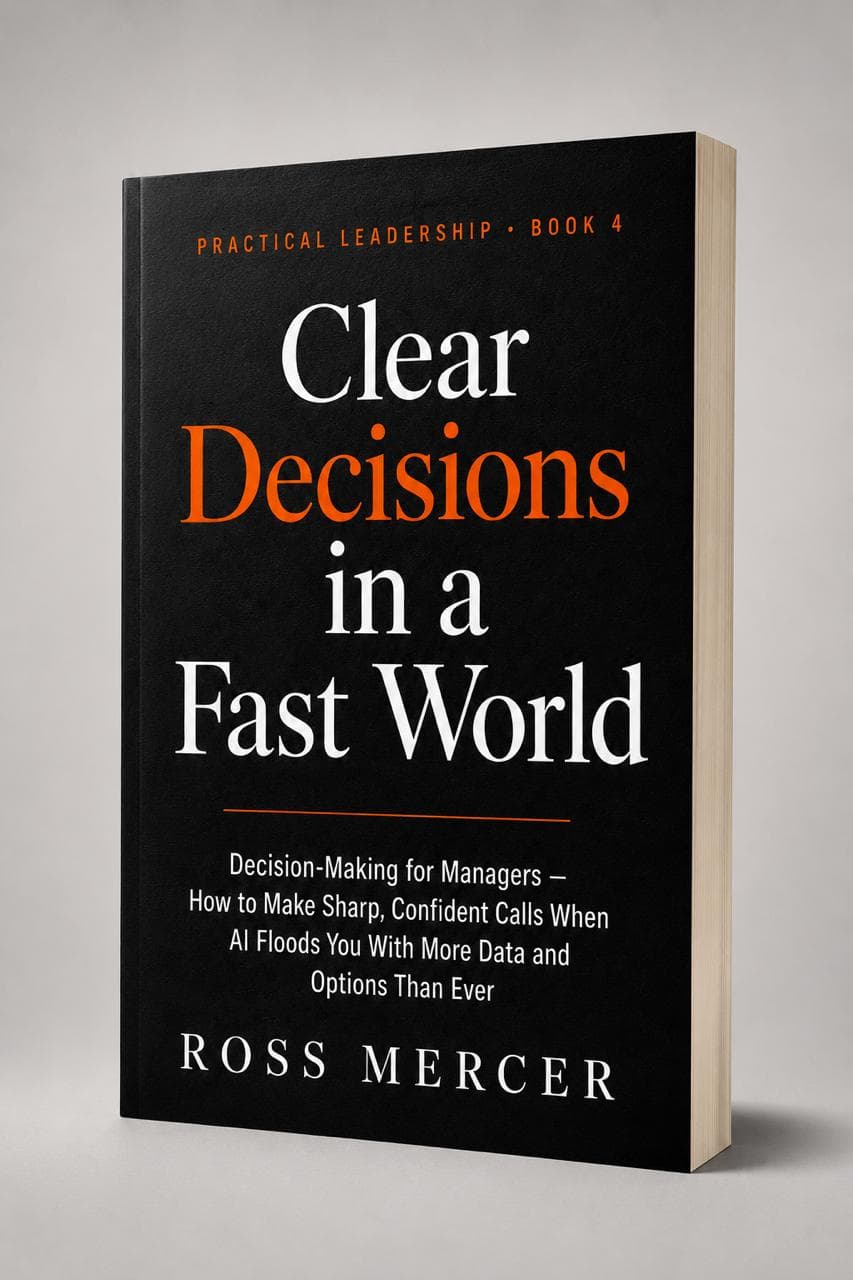
Clear Decisions in a Fast World
Make sharp, confident calls when AI floods you with more data and options than ever. E-book $14.99 · with the Decision Toolkit $79.